

Google DeepMind just published the most concrete map of life after AGI I have read this year, and the line that stopped me is one sentence about compute.
On November 19, research scientist Tim Genewein posted What comes after AGI? on the DeepMind Institute, the platform Shane Legg opened in September to take the AGI debate public. It condenses From AGI to ASI, a report Genewein wrote with 13 co-authors, Legg, Allan Dafoe and Marcus Hutter among them. Their argument is that life after AGI has moved from philosophy to measurement, and the measurements point to fast progress through the next decade.
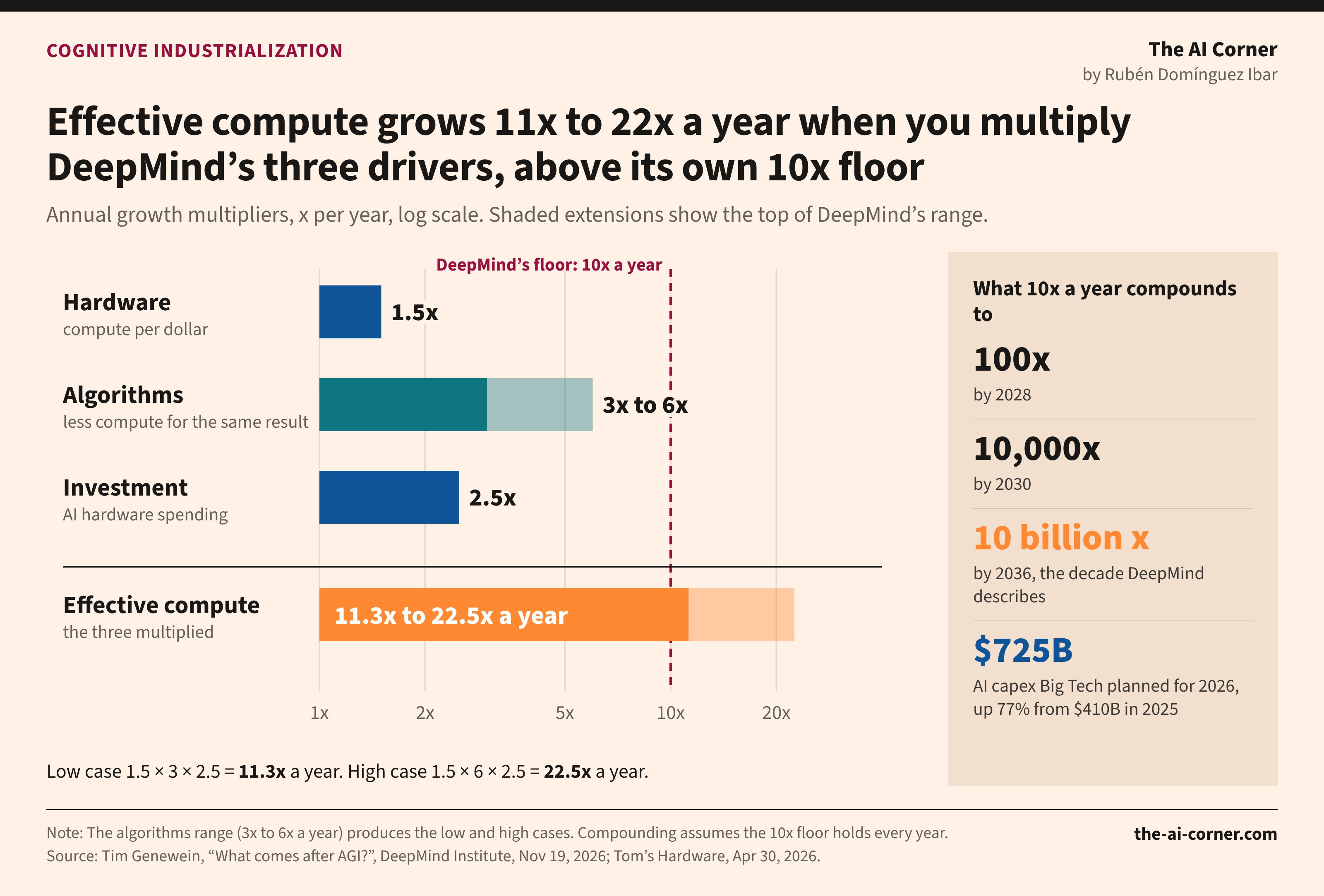
Here is the sentence. DeepMind multiplies three drivers, hardware at about 1.5x a year, algorithms at 3x to 6x and investment at 2.5x, and gets global effective compute growing at least 10x a year. Run that for a decade and you have 10 billion times today’s stock.
I built the premium kit at the bottom of this post around that math, because the numbers are specific enough to plan with: a 6-tab Excel model, a 16-signal tracker and 12 Claude prompts that show the month each of your workflows becomes AI-ready. The free part walks through the report first.
Cognitive industrialization
DeepMind’s name for this wave is cognitive industrialization. Mechanical industrialization turned routine physical labor into a commodity, and the report expects the same for routine thinking, even if frontier research stalls.
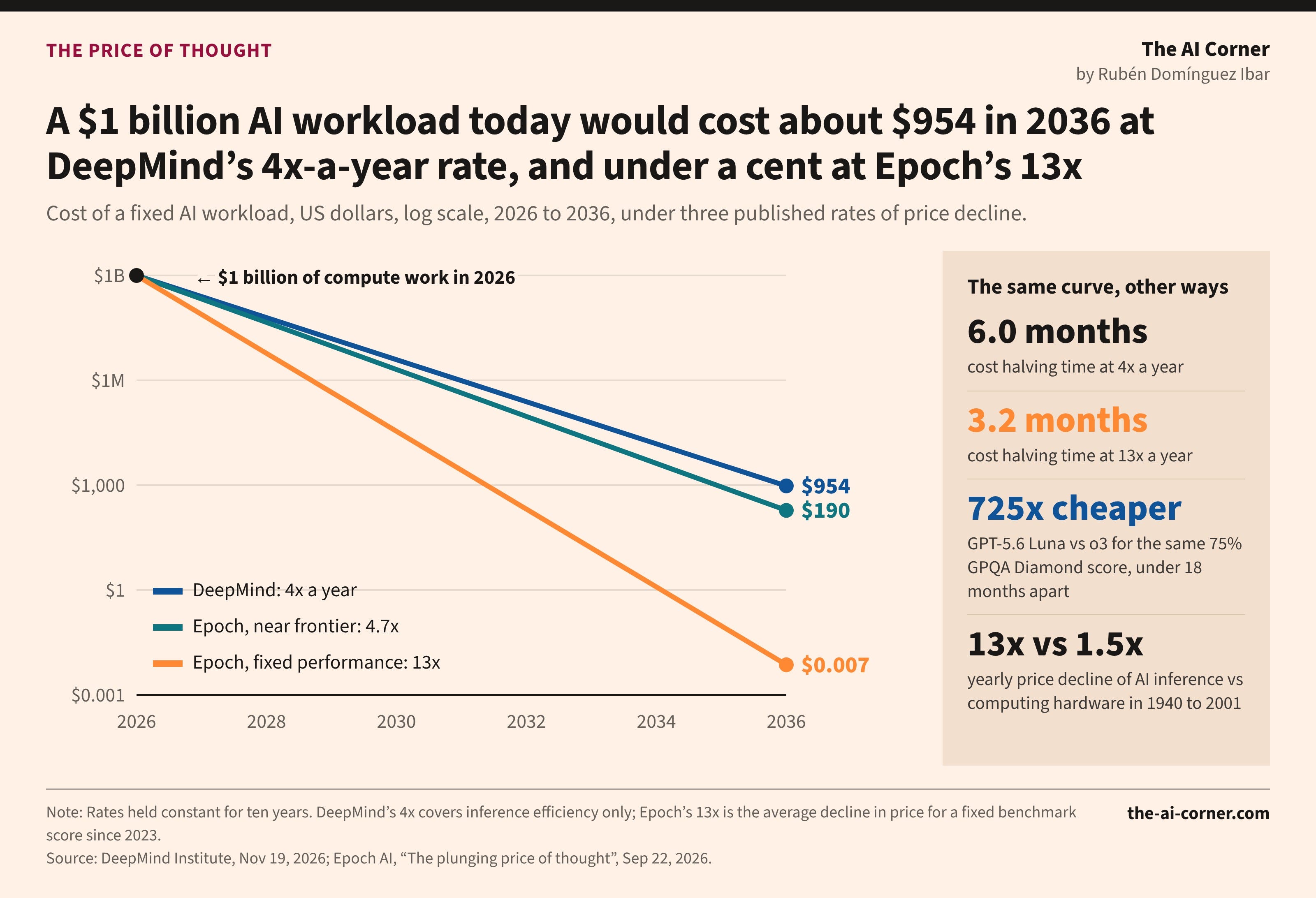
The cost side moves just as fast. Inference efficiency alone cuts compute demand about 4x a year, so a workload costing $1 billion of compute today would cost about $1,000 in ten years. I checked the math: $1 billion divided by 4 to the tenth power is $954.
Epoch AI measured something steeper in September. The price of a fixed level of AI performance has fallen about 13x a year since 2023, and GPT-5.6 Luna matched o3’s 75% score on GPQA Diamond for 725 times less per question, less than 18 months after o3 shipped.
The cost curve will reshape your company before any AGI announcement does. Sam Altman put the drop at 100x in two years, and the 9 bottlenecks deciding who wins in AI show where cost still bites.
How long an agent can work alone
Cheaper thinking matters once agents can hold a task together for hours, and METR keeps that scoreboard. Its time horizon is the length of task, in skilled-human hours, that an agent finishes half the time.
Claude 3.7 Sonnet sat at about one hour in February 2025. GPT-5 reached 2 hours 17 minutes that August, and an early version of Claude Mythos Preview tested at about 17.4 hours in March 2026. METR’s Time Horizon 1.1 update puts the doubling time at 88.6 days since 2024, against roughly seven months across 2019 to 2025.
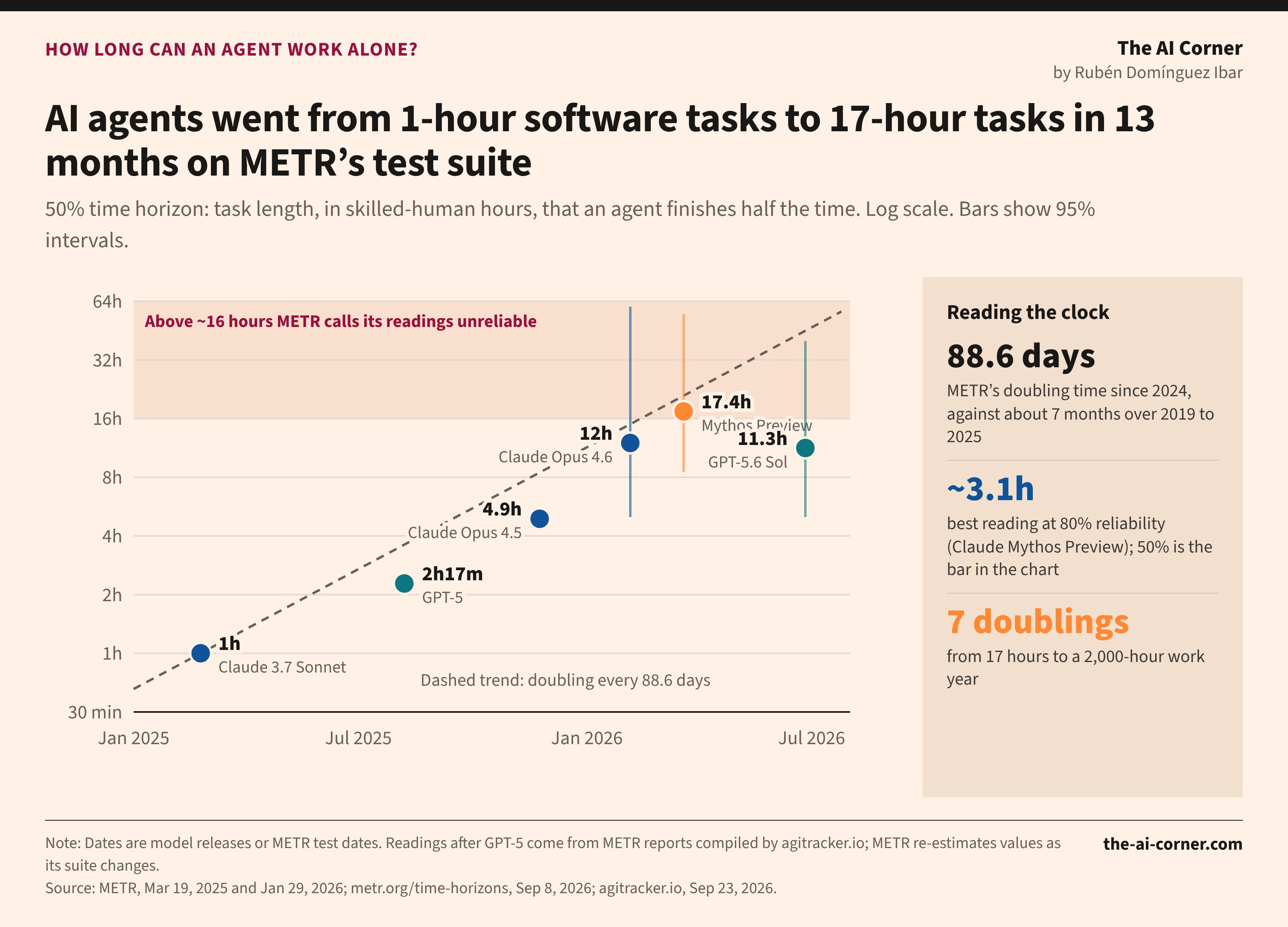
That 17.4-hour reading is the number I trust least. METR says results above about 16 hours are unreliable with its current task suite, and the 95% interval on Mythos runs from 8.5 to 55 hours. At 80% success the best reading is about 3.1 hours, and that is the line I would plan around.
Four roads past AGI
The report’s core is a map. DeepMind defines superintelligence as systems that consistently beat large groups of human experts on work that takes them years, using fewer resources, and it sees four ways to get there from AGI:
Scaling models and data. Bigger models trained on more data, until data supply, power, grids and fabs push back.
A paradigm shift. New methods for what transformers still lack: continual learning, world models, sample efficiency and inventing new concepts.
Agent collectives. Millions of AGI instances coordinated as group agents or whole agent economies, a scale up from 1,000 agents working while you sleep.
Recursive self-improvement. AI improving the code, data and specialization behind the next AI, fastest where results get checked automatically, like math proofs. Most self-improving loops fail for a specific reason.
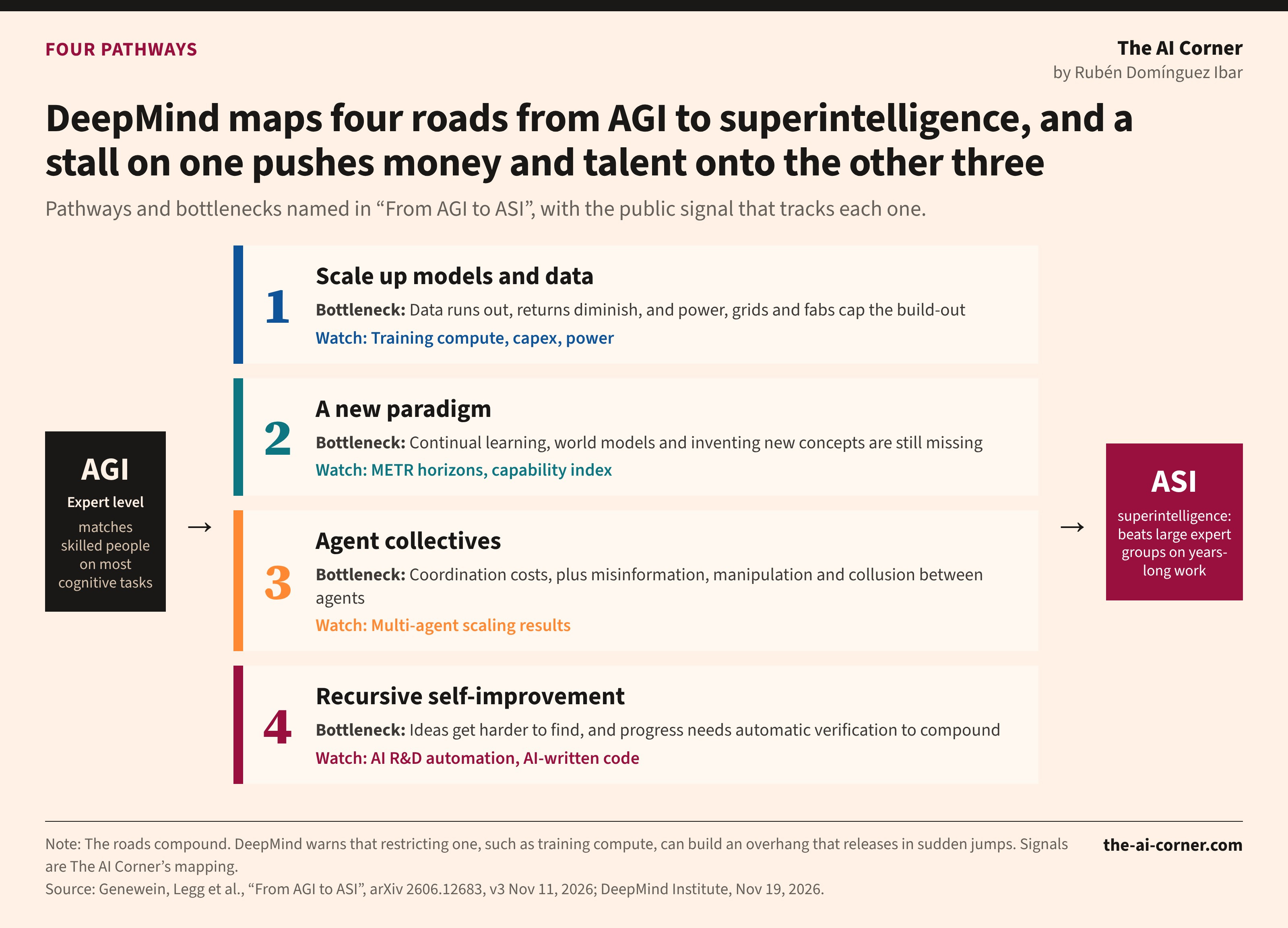
The planning lesson sits near the end of the essay. The roads compound, and when one stalls, economic and geopolitical competition shifts effort to the others. Cap a single input like training compute and you build an overhang that releases in sudden jumps once the cap lifts. DeepMind’s advice for everyone else is “model, measure, forecast, and repeat.”
Who says when
The report avoids firm dates, but Shane Legg, one of its authors, is less guarded in public. He still holds the forecast he made two decades ago, even odds of minimal AGI by 2028, and told the University of Auckland this month that “we’re getting very close.” At Davos in January, Demis Hassabis said he is still on his 50% by the end of the decade, and Dario Amodei, on the same stage, said AI better than humans at everything might arrive in one to two years.
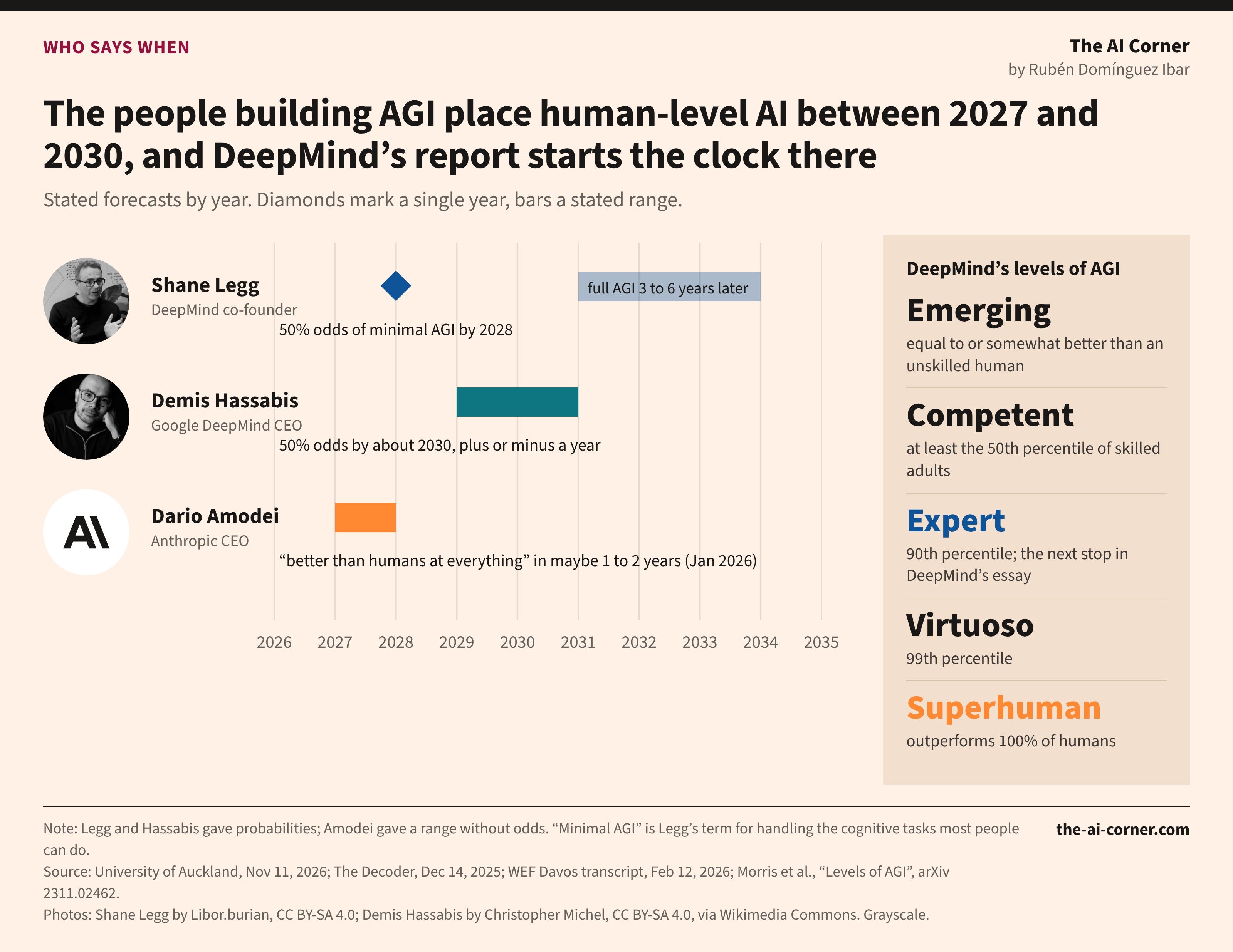
Legg walks through minimal AGI, full AGI and superintelligence with Hannah Fry on the Google DeepMind podcast:
Hassabis, speaking at Stanford this spring: “Ten years from now, I think we’ll realize that we were standing in the foothills of the singularity now.”
For the longer read on his bet, see Hassabis Bet His Job on AGI by 2030 and Dario Amodei on “the zeroth world”.
Two moves for this quarter
Re-price every AI line in your budget each quarter. At 4x a year, cost per task halves every six months; at Epoch’s 13x, every 3.2 months.
Put agents on the work under three hours first. That is where 80% reliability sits today, and full-day tasks come next.
Get the Post-AGI Kit
Below the paywall: the Post-AGI Kit, a 6-tab Excel model that dates when each of your workflows becomes AI-ready, plus the 16-signal tracker, the 4-road playbook for founders, investors and operators, and 12 Claude prompts that run it on your company.